To whoever has been following me on my journey with Upwork and trying to figure out this whole remote work thing on the side, I have some bad news.
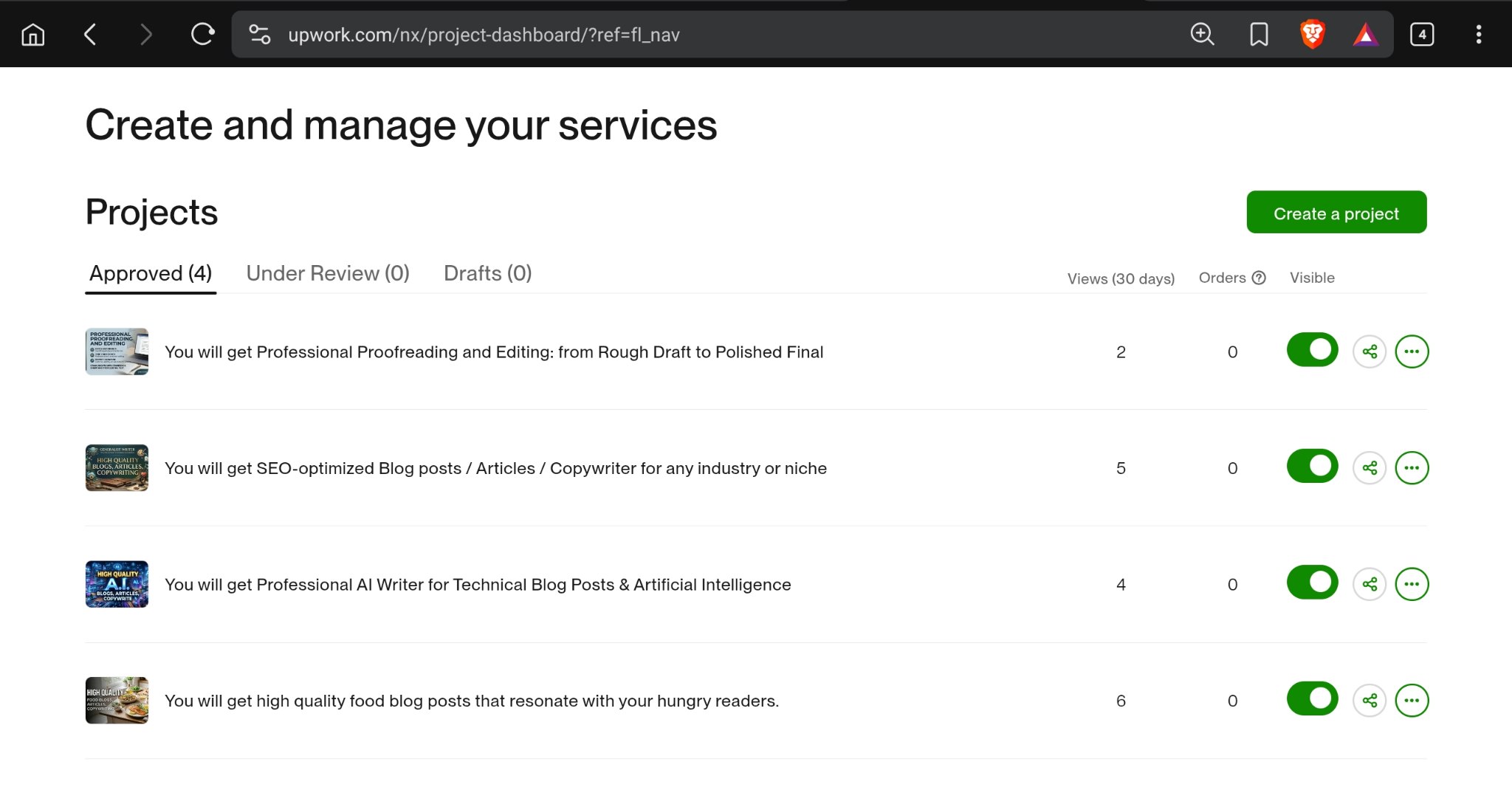
In the past blog, I’ve had plans building my way up to $20 hourly in Upwork and be finally free from the shackles of an office desktop. It may have been a dream. And If you’ve been aware of my other strategy, you know I’ve been trying to build up some passive streams of income that I can easily manage on the weekends without interfering with my day job. Project catalogs seemed like the perfect answer. You set them up once, list your specs, and wait for clients to come to you. But reality hits hard, and right now, the numbers are telling a pretty disappointing story.
Here is exactly what went wrong, the projects I set up, and where I’m pivoting from here.
Testing the Waters with Upwork Project Catalogs
I decided to venture into Upwork’s project catalogs to see if I could get some traction. I managed to get four specific projects approved pretty fast. To be completely transparent, because I’m balancing this with a full-time job, I didn’t reinvent the wheel here. I looked at what Top-Rated Freelancers on the platform were doing, analyzed how they structured their project tiers, and modeled my specs after their proven ideas.
Every single one of these offerings was built strictly around my writing skills. Here is a breakdown of the four catalogs I launched:
- You will get high quality food blog posts the resonate with your hungry readers: This is the one where I feel most at home. It’s a dedicated service for crafting relatable, personal, and highly engaging food blog content, blending standard SEO practices with “eating”—something everyone can relate.
- You will get Professional AI Writer for Technical Blog Posts & Artificial Intelligence: A gig tailored specifically for the growing A.I. industries. This catalog focuses on writing technical blog posts and content centered around what’s hot and what’s not in this tech that everyone loves and hates.
- You will get SEO-optimized Blog Posts/Articles/Copywriter for any industry or niche: A versatile, all-around writing service designed to handle standard articles and copy across almost any industry, built for clients who just need solid, clean content.
- You will get Professional Proofreading and Editing: from Rough Draft to Polished Final: A polished final-touch service. This one takes a client’s rough draft and cleans up the flow, syntax, and grammar to turn it into a professional piece.
The Reality Check: Minimal Views and Zero Orders
So, those were the four catalogs I threw into the ring. The actual results? Sadly, my views over within every last 30 days of the stats have been incredibly minimal. It’s a bit tough to swallow, and honestly, it makes you question what you’re doing wrong.
If I had to guess, a huge factor is the algorithm. Because I’m not currently a Top-Rated Freelancer or a historical top performer on Upwork, my catalogs are likely buried underneath a mountain of established profiles. The platform makes performance metrics incredibly visible, and staring at a big, flat “zero orders” is a clear sign that this specific avenue isn’t moving the needle for me right now. It is simply not profitable.
Pivoting to a Passive Strategy on Fiverr
Even though the Upwork experiment didn’t work as expected, I’m not throwing in the towel on this format just yet. The core logic behind using project catalogs is still exactly what I need. Because it’s a passive medium, I don’t have to spend hours actively pitching and applying for jobs. I can open up the project shop, let it sit, and take on the work over the weekends at a fixed rate.
Since Upwork isn’t delivering the traffic, the next step is to take these exact same four project setups and migrate them over to Fiverr to see how the two platforms compare. We’re going to test the gig ecosystem there, see if the search algorithm treats newer sellers any differently, and see what happens next. Stay tuned.
Leave a Reply