Month: November 2026

  • Exposed: Why Umingle’s Deceptive Trap Extorts Users

    Exposed: Why Umingle’s Deceptive Trap Extorts Users

    Have you ever seen something trending on Google Trends and felt that nagging itch of curiosity to check it out? That was me a few days ago when I stumbled across umingle. I didn’t have grand expectations; I just wanted to see what all the fuss was about. Like most people, I skipped reading the rules and those terms stuff, giving only a quick glance at the front page before diving right in.

    My timing wasn’t ideal, either. I was physically stuck inside a crowded bank waiting in line to encash a cheque. Because I couldn’t exactly turn on a video call right there next to the teller, guards, and other staff, I opted for the text-only chat feature. Little did I know, this casual curiosity would lead to a dead end and leave me deeply skeptical about whether the whole platform is just a clever scam.

    My Casual Chat Turned Into a Sudden Ban

    umingle browser text chat interface

    When the text chat connected, I was paired with someone on the other end. The conversation took a strange, abrupt turn right from the start. The user immediately started venting, typing something along the lines of, “I’m so done with malibog boys.”

    The tone was heavy with frustration and annoyance. Honestly, I felt a bit puzzled and slightly concerned about the weird vibe of the chat. Out of sheer curiosity and a brief moment of human instinct, I simply asked if they were a girl.

    I’ve gotten confused when it said “You wanna be banned?”. In a split second, I got slapped with a permanent ban. There was no warning popup, no polite reminder about community guidelines, and zero chance to explain myself. Just a swift, harsh lockout.

    It Feels Like a Cash-Grab Scam
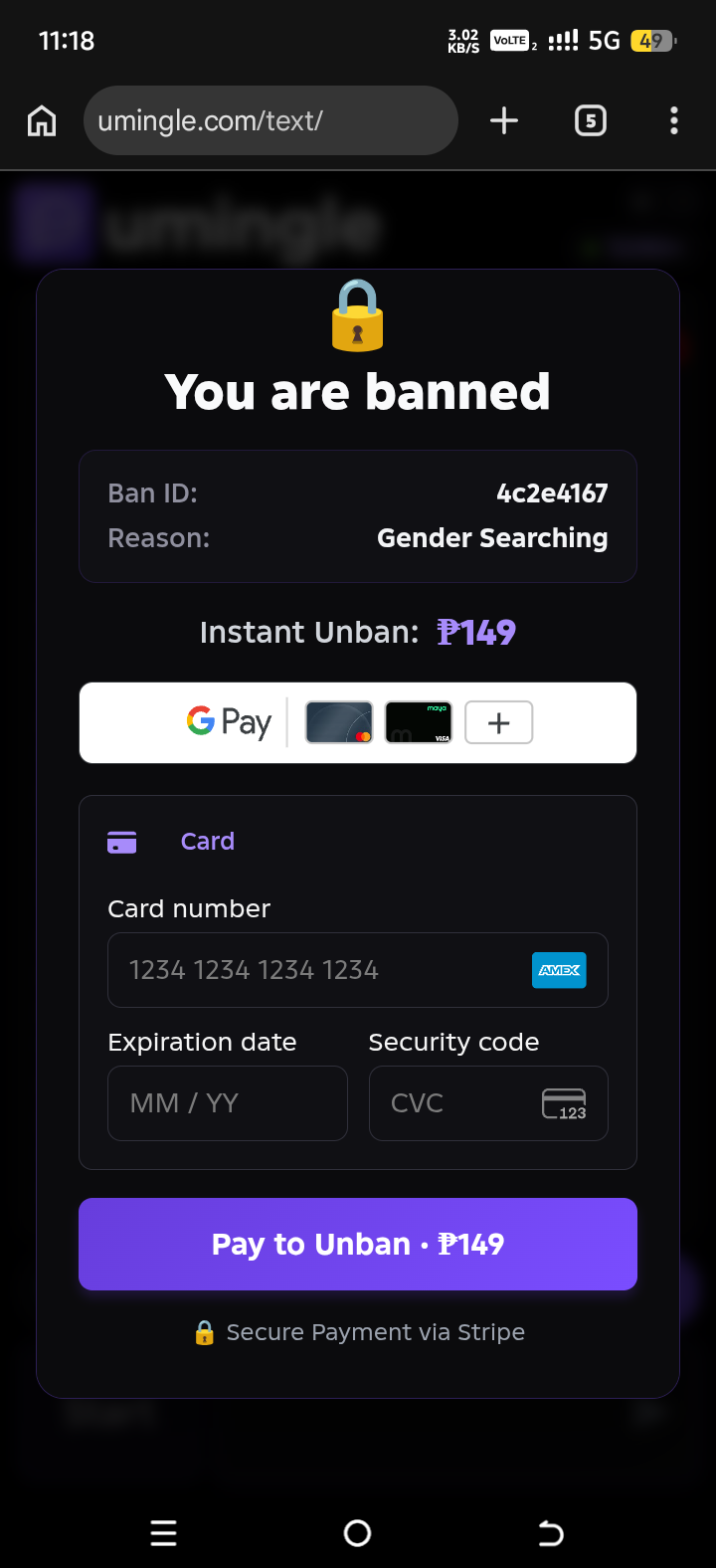
    Umingle ban page. You have to pay by credit card using GPay to unban or unlock your account againt. My reason that got banned was Gender searching.

    At first, I was just shocked. Then, annoyance kicked in. I had no idea that asking about gender was a bannable offense—mostly because I hadn’t memorized an entire rulebook hidden away in some footer link. I was just a curious visitor passing time in a bank queue!

    Things started looking extremely fishy when I a pop-up came up asking for me to pay. If I wanted to get unbanned, I had to pay ₱149. That was the exact moment my skepticism went through the roof.

    Let’s look at the logic here. How is an ordinary user supposed to remember every single micro-rule on a platform they just joined five minutes ago? Humans aren’t perfect. If a platform hands out instant permanent bans without any prior warning or proper investigation, something is deeply wrong with how it operates.

    It makes you wonder: were those chat partners even real people? I can’t help but think I might have been talking to automated bots, AI, or internal staff members. Are they baiting users and enforcing ultra-strict bans on purpose just to trap people behind a paywall? Think about it. With thousands of users hopping on out of curiosity—especially impulsive users looking for a connection—a ₱149 unban fee can easily rake in cash. The system gives zero room for human error, punishing innocent slip-ups instantly while profiting off the fix. Naturally, horny or curious men will always find ways to look for girls, making them prime targets for this endless cycle of bans and fees.

    I’m Out

    It makes you wonder: were those chat partners even real people? I can’t help but think I might have been talking to automated bots, AI, or internal staff members. Are they baiting users and enforcing ultra-strict bans on purpose just to trap people behind a paywall? Think about it. With thousands of users hopping on out of curiosity—especially impulsive users looking for a connection—a ₱149 unban fee can easily rake in cash. The system gives zero room for human error, punishing innocent slip-ups instantly while profiting off the fix. Naturally, horny or curious men will always find ways to look for girls, making them prime targets for this endless cycle of bans and fees.I’m Out

    I’m not a rule-breaking menace, and I definitely didn’t deserve a zero-tolerance penalty for a simple, curious question about a stranger’s rant. But more importantly, I refuse to support a system that feels engineered to squeeze money out of unsuspecting users.

    If you’re thinking about checking out umingle because you saw it trending, consider this your warning. Skip it, save your time, and don’t fall for what looks dangerously like a paywalled scam. I’m certainly never going back.

  • Cebu’s 2026 Wage Hike: Why I Won’t See the Extra ₱42

    If you were paying attention to local news recently, you might have caught the headlines about the Regional Tripartite Wages and Productivity Board in Central Visayas (RTWPB-VII) officially issuing Wage Order No. ROVII-27. It officially mandated a ₱42 daily wage increase for minimum wage earners across the region.

    Naturally, whenever money is mentioned, my ears perk up. But as I sat back scrolling through the news feed, a familiar mix of bitter irony and cynical amusement washed over me. Here is a breakdown of what went down, why it happened, and why some of us are watching from the outside looking in.

    Why Did the Wage Hike Happen in the First Place?

    The decision didn’t just drop out of nowhere. The regional wage board approved the hike following extensive public hearings and deliberations across Cebu and nearby provinces.

    The primary driver behind the increase was simple: the rising cost of living. High inflation rates, rising electricity costs, and skyrocketing prices for basic groceries, transport, and daily essentials had drastically eroded worker purchasing power. The government stepped in to recalibrate rates so that minimum wage earners could theoretically keep up with basic survival expenses.

    Under the new order, workers in Class A areas—which includes Metro Cebu (from Carcar City to Danao City)—saw their daily minimum wage move up from ₱540 to ₱582. Meanwhile, workers in Class B areas saw their minimum wage rise from ₱500 to ₱542 per day. Domestic workers (kasambahays) also received a ₱500 monthly bump, bringing their minimum wage to ₱7,500 per month.

    When Was It Implemented?

    This wage order was officially signed in September 2026, published shortly after, and took effect on October 14, 2026.

    So yes, this is technically old news by now. Private sector employees in Cebu should have already seen this adjustment reflected in their paychecks over the past few weeks.

    Who Got the Hike? (Private vs. Public Sector)

    To understand who actually benefited, it helps to break down how employment sectors are split in the Philippines:

    • Private Sector: These are businesses, corporations, and non-government entities owned by private individuals or companies (e.g., retail workers, factory staff, agency workers, service industry staff, private office employees).
    • Public Sector: These are government agencies, public offices, state universities, and government-owned corporations funded directly by taxpayers.

    The wage increase was strictly for private sector workers. Minimum wage orders issued by the RTWPB do not apply to government employees. Public sector salaries are governed separately by national laws like the Salary Standardization Law passed by Congress.

    Unemployment Can’t Even Benefit from This

    Now, here comes my personal reality check. While hundreds of thousands of formal workers across Central Visayas got a bump in their daily pay, I sat right here with zero change in my bank account. Why? Because I’m currently unemployed.

    You can’t get a ₱42 daily pay raise if your daily base pay is zero pesos. It is almost funny watching people celebrate a wage hike while you’re sitting on the sidelines without a formal payroll to attach it to.

    Excited… But Honestly Depressed Due To Inflation

    Even if I were employed in a minimum wage job right now, let’s be completely honest about what ₱42 a day actually does in 2026.

    OMG, an extra ₱42 a day?! That’s over ₱1,000 more a month! Imagine all the extra things I could buy! 🎉

    ..And then reality slaps you right in the face 😞.

    That extra ₱42 sounds nice on paper until you step outside and realize that prices in the Philippines move twice as fast as wage boards can ever meet. By the time a wage order takes effect, inflation has already devoured that extra money five times over. One daily hike barely covers a cup of brewed coffee, a single piece of fried chicken, or half a kilo of rice at current market prices.

    You want to feel excited because any extra cash is technically a win, but deep down, it’s just depressing. The wage increase doesn’t build wealth; it barely keeps your head above water while the tide of inflation keeps rising.

    Small Price with Big Dreams

    The October 2026 wage hike was a necessary move for minimum wage earners in Metro Cebu, but it remains a small bandage on a very large economic wound. For those of us currently between jobs, it’s a friendly reminder of how tough the market is—and for those with jobs, it’s a quick lesson in how fast ₱42 disappears into thin air.

  • Heads Up! DepEd Cebu FY 2026 Purchase Request Deadlines

    It’s that time of the year when things start gearing up for a busy finish. If you’re working with the Department of Education’s Schools Division of Cebu Province, there’s a fresh update you need to keep on your radar. Superintendent Senen Priscilo P. Paulin recently released an unnumbered office memorandum (UM-2026-024) laying out the strict deadlines for submitting approved Purchase Requests (PRs) for all FY 2026 procurement activities.

    Getting ahead of these dates saves everyone a major headache down the road, especially with year-end accounts closing out. Here is a quick look at what you need to know and when your papers need to be in.

    Peek at the Deadlines

    To make sure there’s enough breathing room for processing obligation requests, handling inspections, and clearing payments before the year wraps up, the division set these specific cutoff dates:

    • Competitive Bidding: November 15, 2026.
    • Small Value Procurement (SVP) and Other Modes of Procurement: December 10, 2026.

    Why the Rush?

    These deadlines aren’t just there to keep desks busy—they’re set up to give administrative and finance teams a proper window to conduct required procurement activities, prepare Obligation Requests and Status (ORS), finish up inspection and acceptance, and process payments under proper accounting and budgetary guidelines.

    It all ties back to the government’s policy on efficient fund utilization and making sure budget allocations are obligated and disbursed right on schedule. The memo also includes a clear heads-up: any approved PRs pushed in past these deadlines might not make the cut for processing within the current fiscal year, as it will depend on fund availability, timelines, and auditing rules.

    Immediate dissemination and strict compliance have been directed across all assistant schools division superintendents, chief education supervisors, education program supervisors, section heads, and program owners. If you’ve got procurement activities lined up, it’s definitely time to get those papers moving!